Our flagship treatment · Metal-free implantology
Ceramic implants, metal-free by design.
Replace a missing tooth with a naturally white zirconia implant - a ceramic instead of a titanium alloy, planned around your whole body, for German and English-speaking patients near Lübeck.
Phone hours: Mon–Thu 8:30–13:00 (German time)
02 Why ceramic
A tooth root made of ceramic,
not metal.
For decades, implants meant titanium. Zirconia offers another path - a replacement for a lost tooth root made of ceramic, without a titanium alloy in your jaw.
03 What it is
What a zirconia implant actually is.
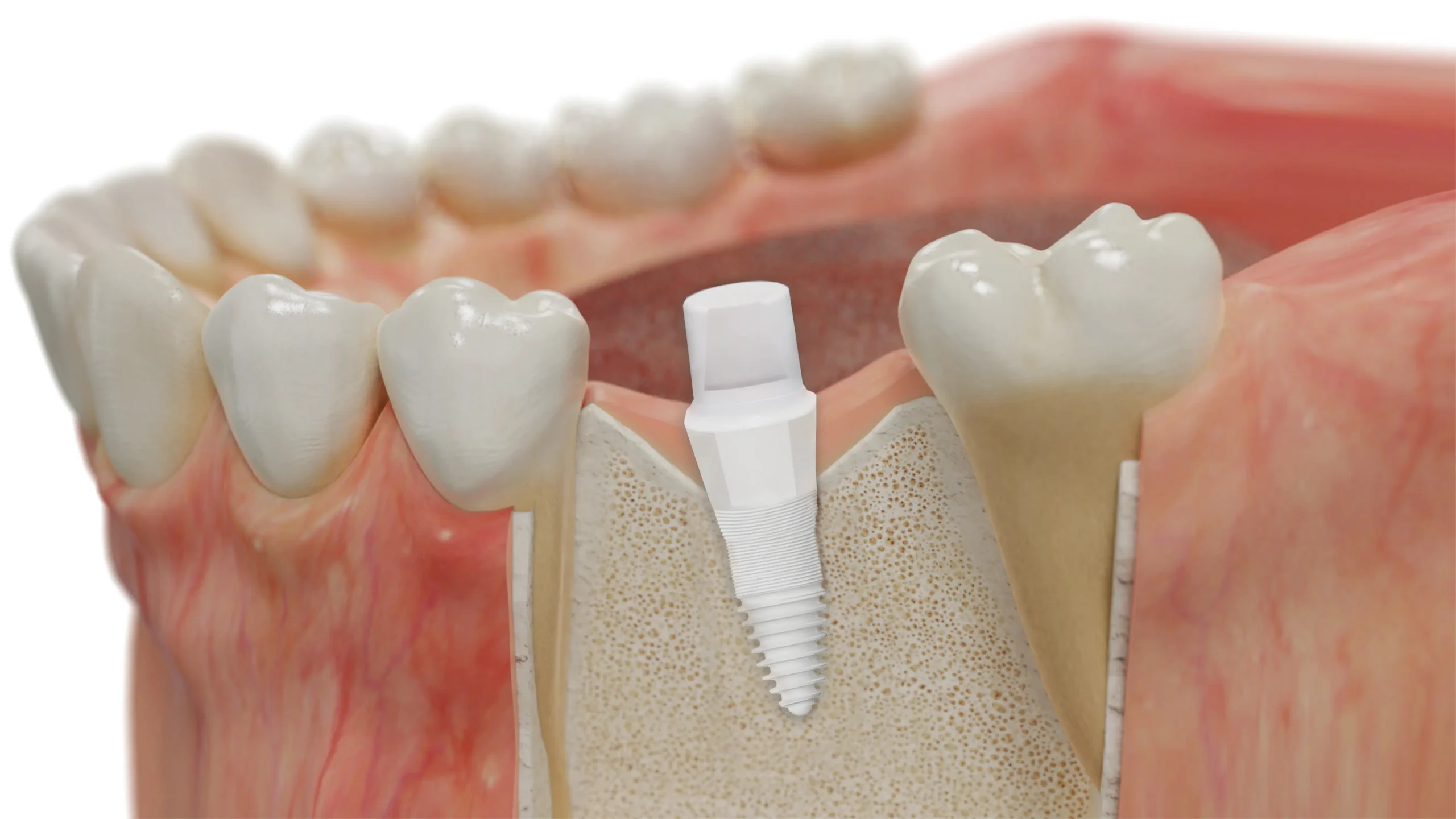
A ceramic implant is an artificial tooth root made from zirconium dioxide - a high-performance ceramic, regarded as bioinert, that has been used in medicine and orthopaedics for many years. Like any implant, it is placed into the jawbone, where the surrounding bone grows onto its surface in a process called osseointegration. Once it has integrated, it carries a full-ceramic crown that looks and works like a natural tooth.
The difference lies in the material: no titanium and no metal alloy. Zirconia does not corrode like metal alloys and does not conduct electricity. For patients who think about their dental work in terms of their whole body, that distinction matters.
- Metal-free by design - zirconia ceramic instead of a titanium alloy.
- Naturally white, so nothing dark shows through the gum.
- A complete, fixed replacement for a single tooth or several.
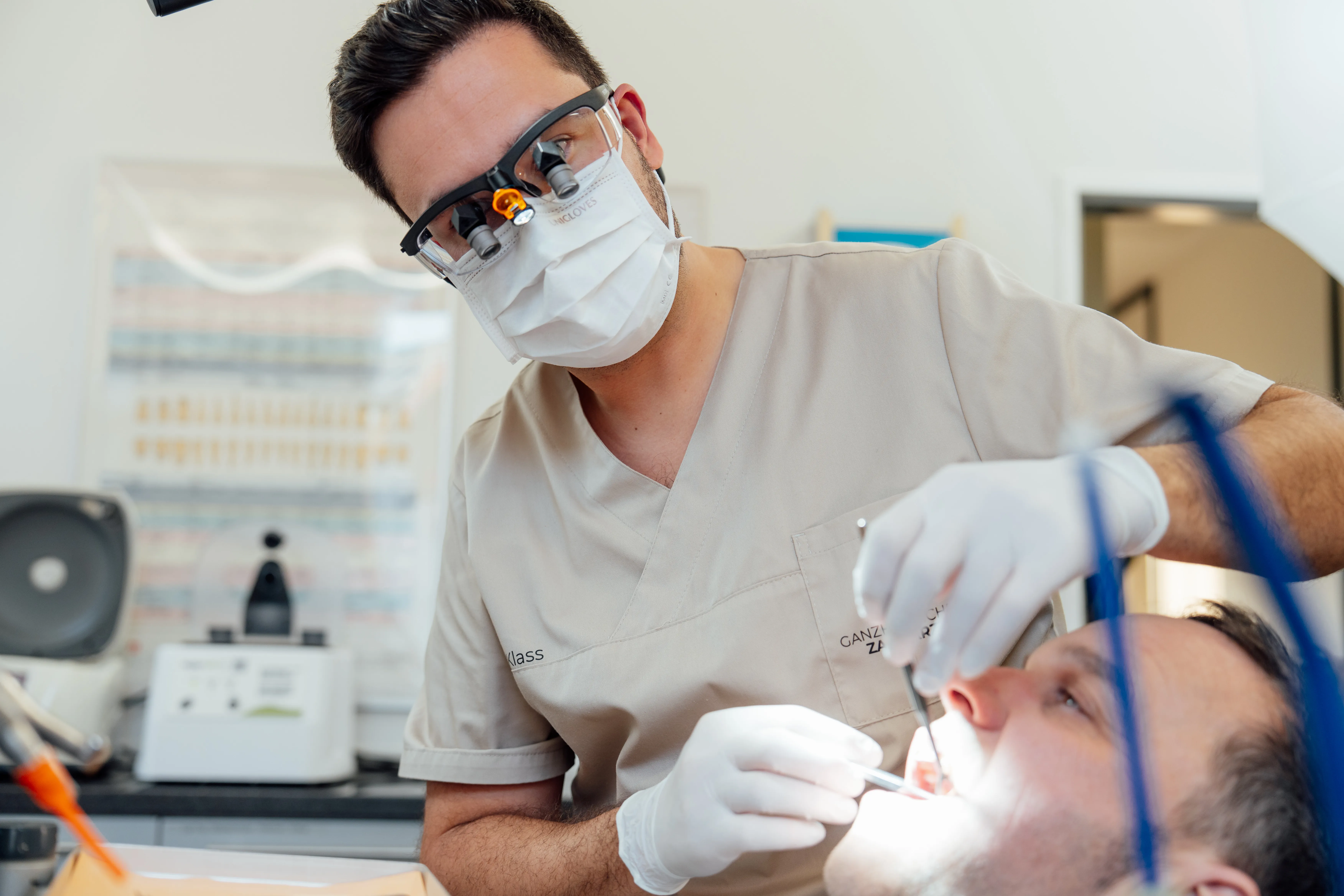
Your treatment is carried out by Dmitri Klass, the treating dentist and a registered member of the Zahnärztekammer Schleswig-Holstein (Dental Chamber of Schleswig-Holstein).
04 The advantages
Why patients choose ceramic over titanium.
- Metal-free by design - zirconia ceramic instead of a titanium alloy. It does not corrode like metal alloys and does not conduct electricity.
- Naturally tooth-coloured zirconia - no grey shimmer through thin or receding gum tissue.
- Bone can integrate with the ceramic surface comparably to titanium (German S3 guideline, 2022).
- Studies suggest that zirconia surfaces may attract less plaque than titanium, which may help the gums around the implant.
- A considered option for patients with known metal sensitivities or a preference for metal-free care.
- Aesthetics that suit the visible front teeth especially well, where titanium can be harder to hide.
Zirconia implants are made of yttria-stabilised zirconium dioxide (some systems use alumina-toughened zirconia). Like any ceramic, they can contain trace elements from the raw materials: an independent laboratory analysis of nine commercial zirconia implant systems found such traces in all samples, while all of them met the applicable ISO standards (Gross et al., 2020). “Metal-free” therefore describes the material class: a ceramic instead of a metal alloy.
05 The evidence
What the evidence says - and where it is still thin.
Ceramic implants are a well-founded option, but not an upgrade for everyone. Here is the current state of knowledge, in plain words and with sources.
In 2022 the German Society for Implantology (DGI) published an S3 guideline - the highest methodological level for clinical guidelines in Germany - on the use of dental ceramic implants (Thiem et al., Int J Implant Dent 2022;8:43). Its key points:
- Titanium remains the international standard, because it has the best long-term data.
- Zirconia is comparable in key respects: its material properties, its soft-tissue behaviour and the way bone integrates with it are described as comparable to titanium.
- One-piece zirconia implants are confirmed as a feasible addition or alternative to titanium implants.
- For two-piece ceramic systems no final conclusion could be drawn yet. The guideline recommends them only after the patient has been informed in detail about the lack of long-term clinical data - which is what we explain before any treatment decision.
A second German S3 guideline from 2022, on titanium hypersensitivity (Müller-Heupt et al., Int J Implant Dent 2022;8:51), names the patient's clinical picture as the leading parameter. Where a titanium-particle-related inflammatory reaction around an implant is suspected, ceramic implants can be considered as an option. Other metals in crowns, bridges or alloys also need to be taken into account as possible triggers.
06 Titanium vs. zirconia
The same job, a very different material.
Titanium implants are well established and work reliably for many people. But titanium is a metal: it can show as a dark line where the gum is thin, it conducts electricity, some patients may react to it, and others simply prefer not to carry metal in the jaw.
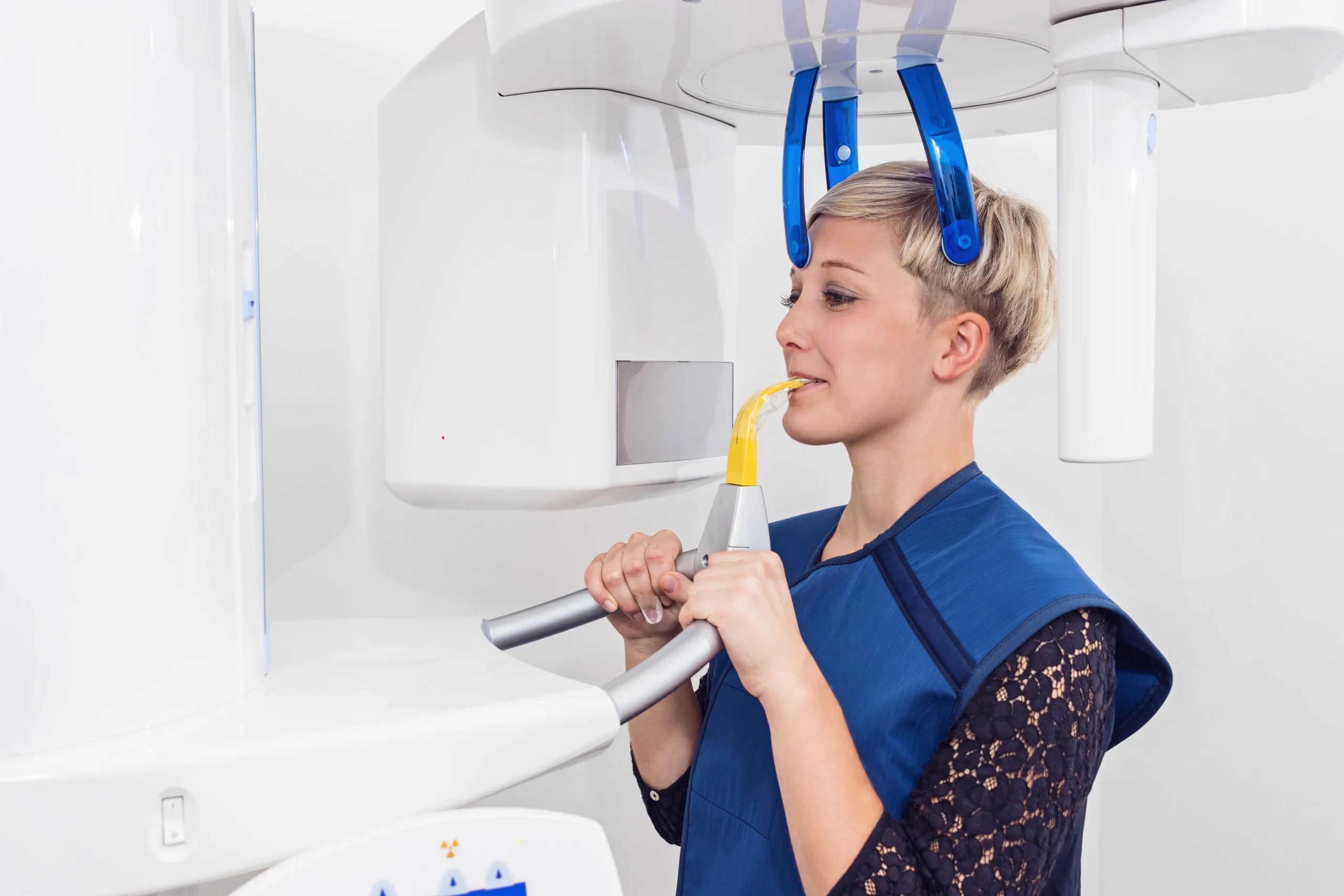
Zirconia addresses these points differently. It is white rather than grey, does not conduct electricity and is a ceramic rather than a metal alloy - while bone can integrate with it comparably to titanium. For us it is not about rejecting titanium, but about offering a genuinely metal-free path for those who want one. Every case is planned with precise 3D / CBCT imaging.
07 What to expect
From consultation to a finished tooth.
Every ceramic implant follows a careful, well-planned path. Here is the shape of it.
Consultation & 3D imaging
We assess your bone, gums and overall health, and plan the implant precisely using low-radiation 3D / CBCT imaging. Our guide to CBCT scan cost explains what this diagnostic step typically involves.
Minimally invasive placement
The zirconia implant is placed under local anaesthesia, as gently and tissue-sparingly as the case allows.
Healing & osseointegration
Over the following months the bone can grow onto the ceramic surface, creating the foundation for the crown.
Your full-ceramic crown
Once integration is complete, a metal-free crown is fitted - restoring a tooth that looks and feels natural.
If you feel anxious about implant treatment, you are far from alone. We work at your pace, explain each step before it happens and answer every question, and the placement itself is carried out under gentle local anaesthesia. Tell us how you feel when you get in touch - it genuinely helps us make the visit calmer for you.
A tooth is part of the body. We replace it the way the whole body would choose.
The principle behind every ceramic implant we place

08 When the case needs more
Bone, timing and the individual case.
Not every implant site is the same. Where bone is thin or has been lost, gentle bone augmentation can rebuild a stable foundation before or alongside placement. Where conditions allow, an implant can sometimes be placed at the same appointment as a tooth removal, shortening the overall journey.
The jawbone itself is examined, too: where an old extraction site or an unclear area in the bone raises questions, it is assessed in 3D before an implant is planned - our page on FDOK / NICO in the jawbone explains why. Healthy gums matter just as much, because inflammation around an implant (peri-implantitis) is one of the main long-term risks for any implant; where needed, biological periodontal therapy comes first.
Which route fits you is decided only after your 3D assessment - never as a template. These decisions are made the same way every choice is made here: as part of a wider biological dentistry approach that keeps your whole-body health in view.
.webp)
09 Who it is for
Is a ceramic implant right for you?
Ceramic implants are well suited to people replacing one or more teeth who want a fixed, natural-looking result without metal. They are often chosen for visible front teeth, by patients with known metal sensitivities, and by anyone who simply prefers a metal-free mouth on principle.
- You want to avoid titanium and metal in your jaw.
- You are replacing a tooth in the visible, aesthetic zone.
- You have a metal sensitivity or follow a holistic approach to your health.
- You want treatment planned around the whole body, not just the gap.
When ceramic may not be the best choice
Ceramic is not the right answer for every situation. The following points do not automatically rule it out, but they are weighed carefully and discussed individually after a 3D assessment:
- Little bone or extensive augmentation needs. Where a lot of bone has to be rebuilt, or only very narrow implants would fit, the choice of material and implant design needs particular care.
- Heavy clenching or grinding. Strong, repeated forces put high demands on any implant. Zirconia is a ceramic and behaves differently from metal under load, so protection such as a night splint, or a different plan, may be discussed.
- Larger bridge constructions. For long-span bridges, the clinical data for ceramic implants are more limited than for titanium.
If titanium turns out to be the more suitable option for you, we will say so and explain why.
10 What it costs
What does a ceramic implant cost?
There is no single price for a ceramic implant, because no two mouths are the same. What your treatment involves - a single implant or several, whether the site needs bone augmentation, the type of full-ceramic crown - only becomes clear once we have examined you and studied your 3D / CBCT images.
So instead of a headline figure, you receive an individual, written and itemised estimate after your assessment. It sets out each step transparently, so you can see exactly what you are deciding on before anything begins - with no obligation to proceed.
Reimbursement may be possible through a private (supplementary) dental insurance - please clarify this with your own insurer before treatment. You receive a standard invoice, itemised by service. Whether a public health system contributes anything is decided solely by your own insurer or authority; we do not advise on this.
11 Coming from abroad
Planning your visit from another country.
Some patients travel to us from abroad for ceramic implants. A little planning makes the journey straightforward.
Usually two trips
Treatment is typically spread over two visits: one to place the implant, then - after a healing phase of several months at home while the bone integrates - a second to fit your full-ceramic crown.
Start with a short message
Before you travel, describe your situation briefly in the request form. We get back to you with the next steps; the examination, including 3D diagnostics, takes place at the practice.
Easy to reach
The practice is around 45 minutes from Hamburg Airport and well connected by rail to Lübeck, a short distance from Bad Schwartau.
Travel notes for your city
If you are coming from Scandinavia, we have written the route, the timing and the practicalities out in full for these cities:
What to check when choosing a ceramic-implant practice in Germany
Whichever practice you choose, these points help you compare on substance:
- System and manufacturer information. Which implant system is used, is it one-piece or two-piece, and can you see the manufacturer's documentation?
- 3D planning. Is the implant planned on a 3D / CBCT scan of your jaw rather than on a 2D X-ray alone?
- Metal-free prosthetics. Are the abutment, the crown and the fixing materials metal-free as well, not only the implant?
- A written cost plan before treatment starts. Do you receive an itemised estimate before anything begins?
- Honest information on the evidence. Does the practice explain the current data, including where long-term data are still limited?
- Aftercare with your home dentist. Is it agreed who carries out check-ups and professional cleaning once you are back home, and how information is shared?
More on staying, timing and getting here on our page for international patients.
12 Related care
Treatments that go hand in hand.
Ceramic implants rarely stand alone. These are the treatments most often planned alongside them.
Biological Dentistry
The whole-body philosophy that every ceramic implant decision is made within.
023D / CBCT Imaging
Precise, low-radiation 3D diagnostics used to plan each implant safely.
03Vital Aesthetics
Natural, tooth-preserving aesthetics for a healthy smile, metal-free throughout.
04Safe Amalgam Removal
Protocol-based removal of old metal fillings for sensitive patients.
053D CBCT scan: cost and what it includes
What a 3D CBCT (DVT) scan costs, when it is needed and what is included.
06Micronutrients and dental health
How vitamin D, K2, magnesium and other micronutrients support teeth, gums and bone.
13 Questions
Ceramic implants - good to know.
Ceramic implants are made of high-performance zirconium dioxide (zirconia) rather than metal. They replace a missing tooth root in the same way a titanium implant does, but they are made of a ceramic instead of a titanium alloy, are naturally tooth-coloured and avoid the grey shimmer that titanium can show through thin gum tissue. Titanium has the longer track record and the most long-term data; zirconia is described in the German S3 guideline (2022) as comparable in material, soft-tissue and bone-integration behaviour.
Zirconia is a high-performance ceramic that has been used in medicine for many years. It does not corrode like metal alloys and does not conduct electricity, and the German S3 guideline (2022) describes its soft-tissue and bone-integration behaviour as comparable to titanium. That is why many patients with metal sensitivities or a preference for metal-free care consider ceramic implants. Whether they suit you is discussed individually.
After placement, the implant needs a healing phase to integrate with the bone - typically in the region of several months, depending on your individual situation and whether any bone augmentation is required. The final full-ceramic crown is fitted once integration is complete.
Implant placement is carried out under local anaesthesia and is usually described as comparable to a tooth removal. We plan every case with 3D imaging and work as gently and minimally invasively as possible.
Yes. The practice welcomes English-speaking and international patients. We are based at Hauptstraße 50 in Bad Schwartau, near Lübeck, with good connections to Hamburg, and consultations can be held in English and German.
There is no single price, because every mouth is different. After a 3D / CBCT assessment and an examination, you receive an individual, written and itemised estimate covering the implant, any preparatory steps such as bone augmentation and the final full-ceramic crown. This lets you see exactly what your treatment involves before you decide. Reimbursement may be possible through a private (supplementary) dental insurance - please clarify this with your own insurer before treatment. You receive a standard invoice, itemised by service. Whether a public health system contributes anything is decided solely by your own insurer or authority; we do not advise on this.
Modern zirconia implants are designed as a long-term tooth replacement, and studies to date are encouraging - although long-term data are less extensive than for titanium, especially for two-piece systems. Real-world longevity always depends on the individual - on oral hygiene, gum and bone health, regular check-ups and habits such as smoking or grinding - so no honest dentist can promise a fixed lifespan. Well-integrated implants that are looked after can serve you for many years, and we plan every case to give the implant the best possible foundation.
Often yes. Where bone is thin or has been lost, gentle bone augmentation can rebuild a stable foundation before or alongside the implant. Whether augmentation is needed, and which technique fits, is decided only after your 3D / CBCT assessment - never as a template. In some cases enough bone is present and no augmentation is required. Your written estimate reflects whichever route suits your individual situation.
Ceramic implant treatment is usually spread over two trips. On the first trip the implant is placed; it then needs a healing phase of several months to integrate with the bone, which happens at home. On a second trip, once integration is complete, the full-ceramic crown is fitted. Before travelling, you simply describe your situation briefly in the request form, and we get back to you with the next steps; the examination, including 3D diagnostics, takes place at the practice. The practice is around 45 minutes from Hamburg Airport and well connected by rail to Lübeck. You can read more on our page for international patients.
A one-piece implant combines the part in the bone and the post for the crown in a single piece of zirconia; because the post sits above the gum from the start, it usually needs protecting from chewing forces while the bone heals, and there is less room to adjust the angle of the crown. A two-piece implant has a separate post that is connected later, so the implant can heal under the gum without load and the crown can be aligned more freely. According to the German S3 guideline (2022), one-piece zirconia implants are a feasible alternative to titanium, while long-term data for two-piece ceramic systems are still limited - patients are informed about this before treatment. Which design suits you is discussed individually after the 3D assessment.
A question about your own case that isn’t answered here? Ask us directly →
14 Get started
Request your ceramic implant consultation.
Tell us about the tooth you want to replace. We reply personally - in English - with the next steps and, after an assessment, an individual written estimate.
Practice
Hauptstraße 50
23611 Bad Schwartau
Germany
Ready for a metal-free smile?
Tell us about your situation and the tooth you want to replace. We reply personally - in English - with the next steps.
Phone hours: Mon–Thu 8:30–13:00 (German time)